KEY INSIGHTS
Based on preliminary vote counts:
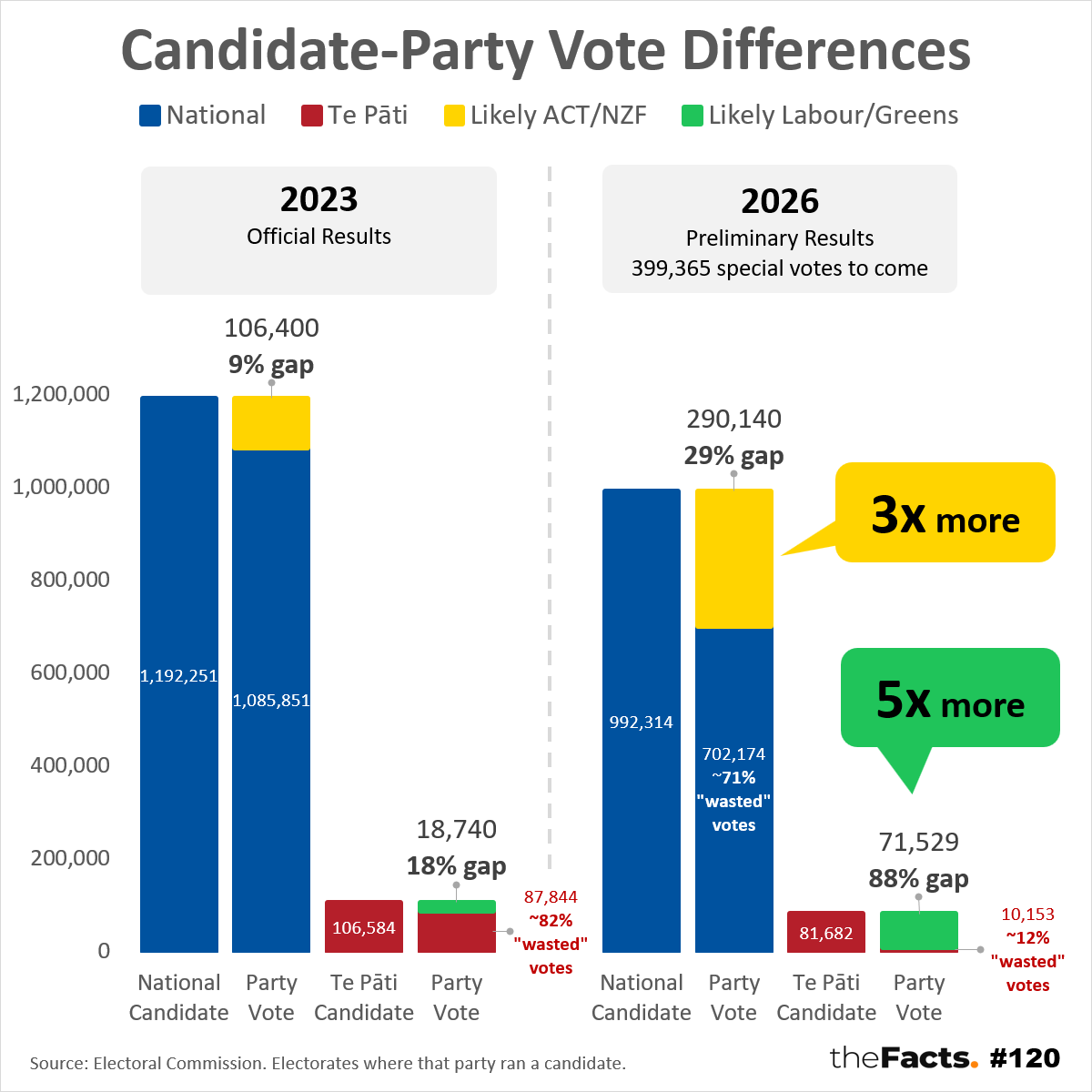
- ~3x bigger National candidate-party vote gap in 2026 (29.2% v 8.9%)
- ~5x bigger Te Pāti Māori candidate-party vote gap in 2026 (87.6% v 17.6%)
- ~702,174 (71%) of these National party votes were “wasted” in 2026 (up from 0 and 0% in 2023)
- ~10,153 (12%) of these Te Pāti Māori party votes were “wasted” in 2026 (down from 87,844 and 82% in 2023)
KEY NOTES
- National and Te Pāti Māori party votes cast by voters supporting other parties’ candidates are also “wasted” under our definition, but aren’t captured in these calculations or in the above graph. See https://thefacts.nz/wasted-party-votes-2026/ for the full “wasted” party votes tallies.
- These figures compare total candidate and party votes, NOT individual split votes. A National candidate/ACT party voter can cancel out an ACT candidate/National party voter in the totals.
- The Electoral Commission’s Split Vote Reports reveal actual split voting totals. Their release for 2026 is uncertain. We’ve asked the Commission for clarification.
- Illustrative example:
- 10,000 people vote for the National candidate.
- 7,000 people party vote National in that electorate.
- Intuitively, this suggests 30% split voting, but the actual rate could be much higher, e.g. of the 10,000 National candidate voters, one possible breakdown might be:
- 6,000 party voted National
- 1,500 party voted ACT
- 1,000 party voted NZ First
- 1,000 party voted Labour, Green, or Opportunity
- 500 party voted for other small parties
(Another 1,000 voters supporting other candidates also party vote National, bringing National’s total party votes to 7,000.)
Result: 30% candidate-party vote gap, but 40% actual split voting among National candidate voters.
- Split voting amongst all voters was 27% in 2020 and 36% in 2023. It is likely to have exceeded 40% in 2026, and possibly even 45%.
5 KEY QUESTIONS
- Was National right to reject the split-voting strategy?
- Could that decision cost the Coalition its majority, and the ability to form a government?
- Did Te Pāti Māori and their voters outthink the National Party and their voters?
- How much did media coverage of split voting, on both sides, influence voters?
- Has MMP changed forever? Will electoral reform follow?
…
HAVE YOUR SAY

…
FULL DATA ANALYSIS
Please contact us if you would like the full data set and research.
…
ADDITIONAL NOTES
- We focused on National and Te Pāti Māori because they were the two parties whose electorate-seat wins contributed to the 2026 overhang.
- We included only electorates where each party stood a candidate. This excludes six Māori electorates for National (they did run one candidate in one Māori electorate which has been counted) and 64 general electorates for Te Pāti Māori.
- We’ve used representative party colours, with yellow for likely ACT/NZF votes and green for likely Labour/Greens votes, to provide contrast rather than black on blue or red on red.
- “Wasted” votes is a contested term. Here, we define them as party votes that produced no additional seats but could potentially have done so if cast for a Coalition or Opposition partner.
- All numbers are provisional and subject to revision.
Thank you to the Factors who helped pull this together.
…
SOURCES
2023 Party and Candidate Vote Totals: https://www.electionresults.govt.nz/electionresults_2023/statistics/overall-results-summary.html
2023 Split Vote Reports (not shown in graph, but useful to see the 27% split voting average in 2020 and 36% in 2023): https://www.electionresults.govt.nz/electionresults_2023/statistics/split-votes-index.html
2026 Preliminary Results: https://www.electionresults.govt.nz/electionresults_2026_preliminary/
Data published by Electoral Commission
(c) Crown Copyright
Licensed for use under the creative commons attribution licence (BY) 4.0
…
Did we make a mistake, or have you got smarter data? Let us know.